




Types of Dies and Die-Mounting Systems
The types of foil dies used in print shops include both flatbed and rotary dies. Each die type clearly affects print quality, durability, and production cost in different ways.
Common foil dies vary as follows:
- Flatbed – made from magnesium, copper, and brass
- Full rotary brass die
- Segmented rotary brass die – uses a partial cylinder or mold instead of a full cylinder
- Flexible metal sleeves mounted on a magnetic cylinder
Types of Flatbed Dies
Metal dies used in flatbed processes are less complex than those used in full rotary systems. Flat dies are non-curved and can be chemically etched or mechanically engraved in a flat form. Once the image has been etched or engraved, the die is ready to be mounted on the press.
1. Flatbed Magnesium Die
Magnesium is the softest and least expensive metal used for die-making, and it is the most suitable for flatbed foiling—especially for short “single-image” runs (see Figure 1).
Image formation on a magnesium plate is done via chemical etching. A photosensitive coating is applied to the magnesium sheet, which is then contact-exposed with a negative film of the desired image and developed to create the image area. The plate is then chemically etched to remove the “non-image” areas, leaving the “image” area in relief.
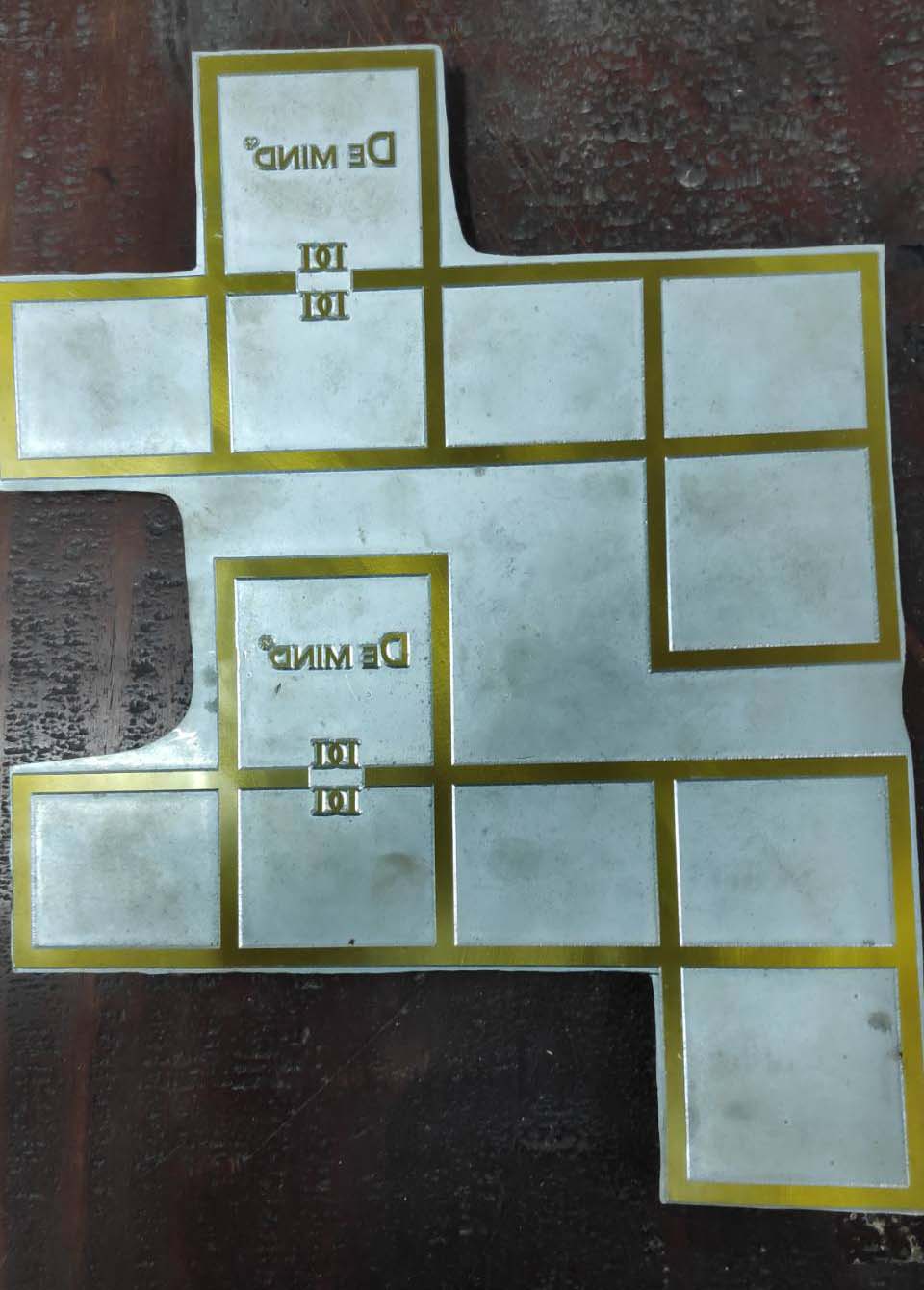
Figure 1 – Flatbed foiling die
2. Flatbed Brass Die
Whereas magnesium dies are produced by chemical etching, flatbed brass dies used in industry are imaged using CNC-driven digital engraving. This method is used for both flatbed and rotary dies.
Flat dies are engraved on a flat surface. The engraving head travels over the die, moving along the X and Y axes and raising/lowering per the digital data to produce highly detailed images.
Brass is an excellent heat conductor and is favored for hot foil stamping used in label production. The temperature of a brass die can be controlled more precisely than magnesium, and its durability makes it better suited for long production runs.
3. Flatbed Copper Die
Copper dies are imaged by a chemical etching process similar to that used for magnesium.
Copper is harder than magnesium and is better suited for longer runs and multi-image jobs. Well-controlled chemical etching yields excellent foiling results.
Types of Rotary Dies: Full Brass System
Producing rotary foiling dies requires more engineering than flatbed dies.
The process begins with a metal length whose outside diameter matches the printed web circumference for the job and the required foil repeat length.
The inner section of the die is machined out to form a tube, and end caps are fitted precisely to the die. Oil feed couplings are installed to allow heated oil to flow in and out through the center of the die.
Alternatively, the die can be heated electrically by inserting heating elements inside and securing them firmly at the ends of the die.
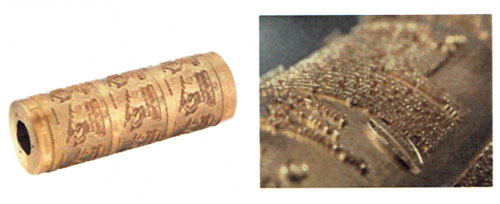
The rotary die is imaged using the same principle as flat engraving. Instead of the head cutting along both X and Y, the head travels along the X axis only, while the rotary die oscillates back and forth along the Y axis with the head raising and lowering as required. This complex engraving system is driven by a digital file containing the image to be engraved. Figure 2 shows a completed rotary die with the image engraved.
Types of Magnetic Dies: Rotary Sleeves
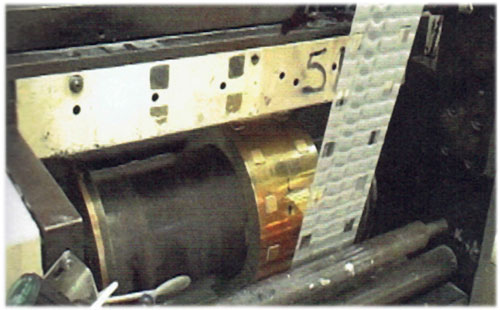
Another option for rotary foiling dies is the sleeve system. This type reduces the mass of a rotary die by creating an image-specific sleeve only as wide as the image area needed.
In Figure 3, an imaged brass sleeve is placed over a heated base cylinder and secured. The sleeve slides onto the cylinder and can be positioned both laterally and circumferentially to achieve correct registration. The figure also illustrates using a narrow foil web even when the job’s web width is larger.
- Segmented (modular) dies
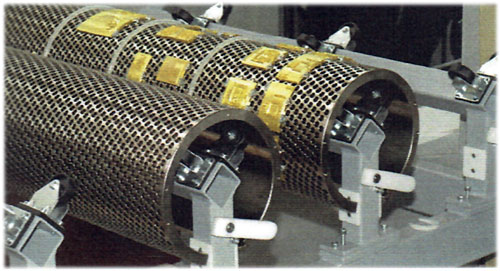
The die shown in Figure 4 is called a segmented die. This is an innovative way of mounting individual brass foiling dies onto a full rotary cylinder without using a single continuous (and expensive) brass shell.
The cylinder is made in a honeycomb pattern to facilitate clamping along the edges of each die segment.
The curved die segments are securely mounted onto the honeycomb base using tension keys that tighten the clamps.
Types of Magnetic Dies: Fast Changeovers in Production
Magnetic foiling dies operate on the same principle as flexible steel dies used for label die-cutting.
The die is made from a flexible “thin plate” with a steel backing and a copper face layer that carries the foiling image. Copper is used because it is an excellent conductor of heat. The imaged thin plate is positioned onto a heated magnetic cylinder (see Figure 5), and the cylinder and die are installed in the foiling unit in the same way as a rotary plate.
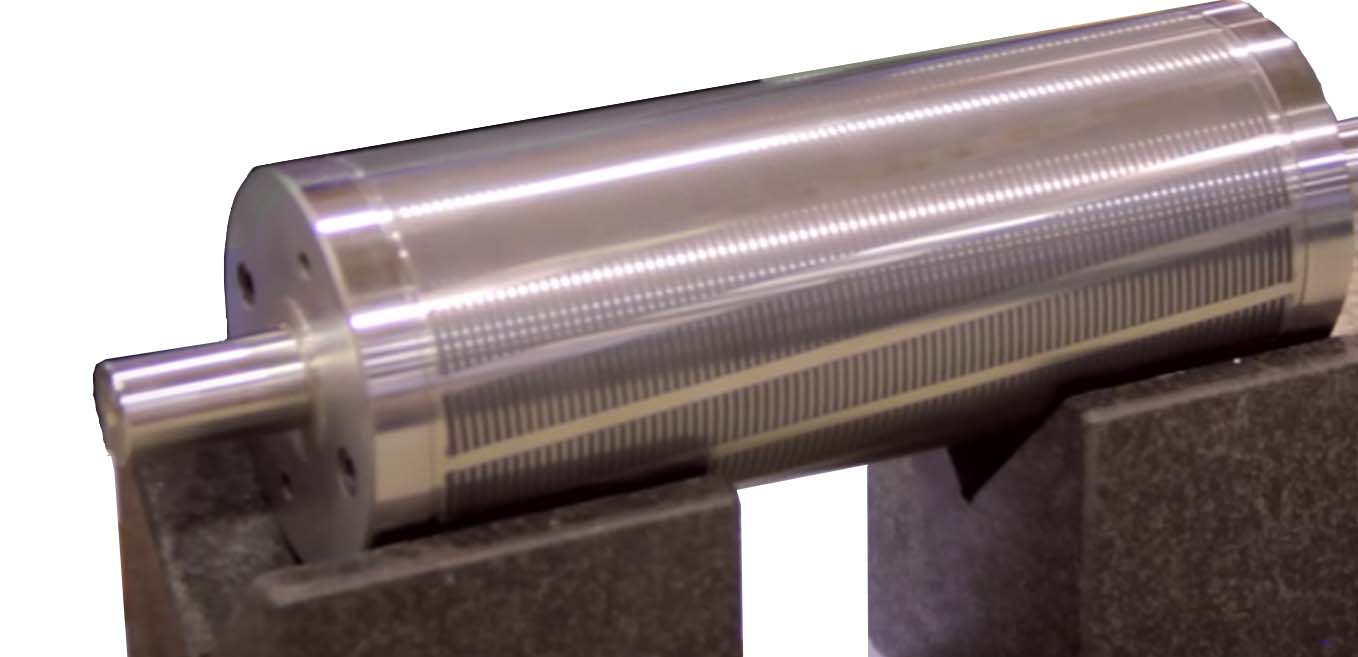
Image formation on these thin foiling plates follows the same chemical etching approach used for flatbed copper dies.
Mounting and removing the thin foiling plates is very easy, especially when the magnetic cylinder has register pins that match the plate’s positioning holes, making registration straightforward. A key advantage of this die type is the ease of job changeovers during production.