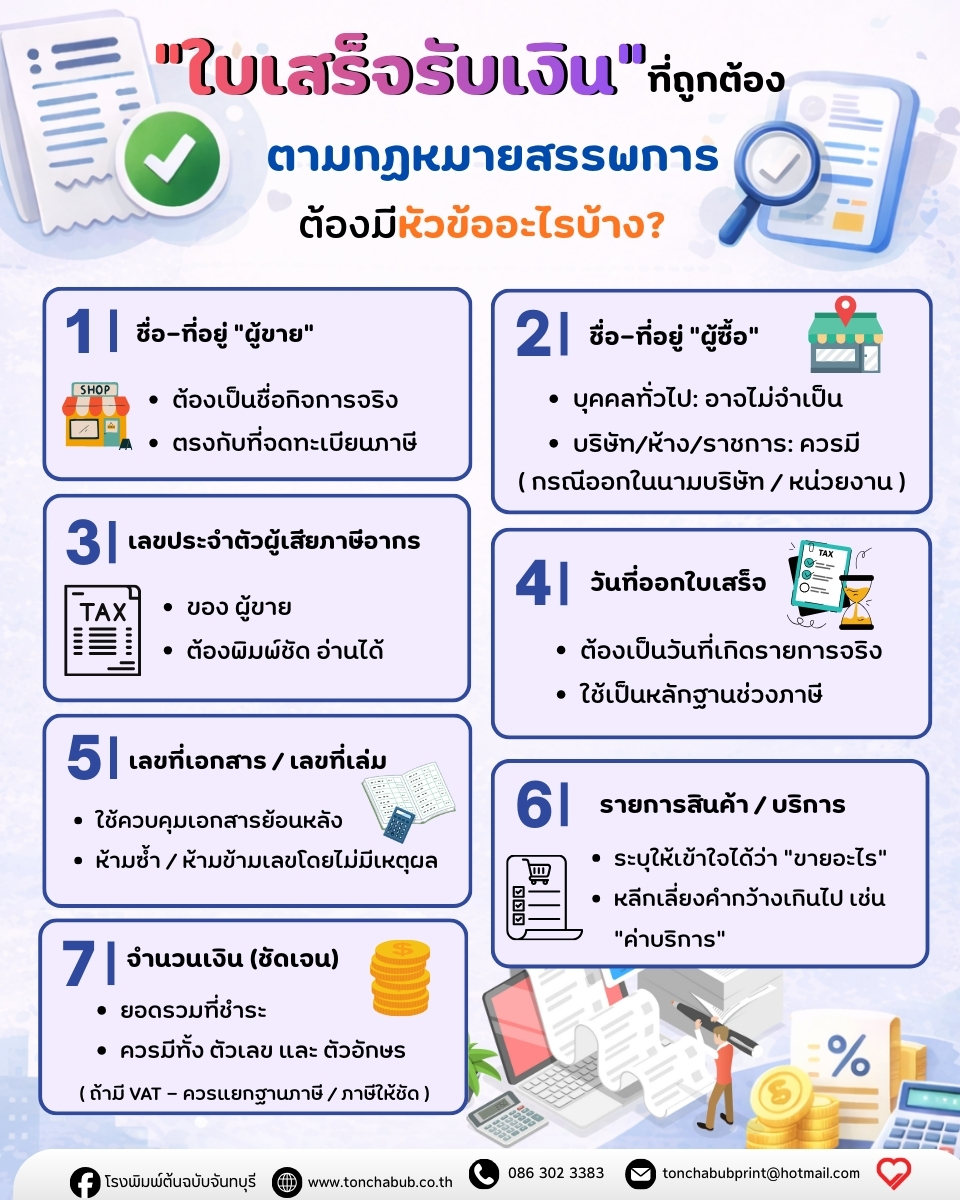
This article explains in detail what components a legally compliant receipt must have according to the Revenue Department, with step-by-step explanations to ensure shops, businesses, and entrepreneurs can use them correctly and safely.
Summary: A receipt is a document issued by a seller to a buyer to confirm that payment for goods or services has been received, and it can be used as evidence for accounting and tax purposes.
Why Must a Receipt Be "Tax-Compliant"?
Many businesses mistakenly believe that a receipt containing just the shop name and the total amount is sufficient.However, by law, the Revenue Department places great importance on the details within the document. If a receipt:
- Has incomplete information
- Is unclearly specified
- Or does not reflect the truth
Items a Receipt "Must Have" According to Revenue Standards
Below are all the key headings, expanded for full clarity:1. Seller’s Name and Address
Must be the actual business name- Use the formal name of the shop or company that actually operates the business.
- Avoid using informal nicknames or unofficial abbreviations.
- If registered as an individual → Use the individual's name + Shop name.
- If registered as a juristic person → Use the full company name.
2. Buyer’s Name and Address
For general individuals- It may not be necessary to specify the buyer's name.
- The receipt can be issued as "Cash" or left without a name.
- The buyer’s name and address should be clearly specified.
- Especially in cases where the buyer needs to use the document as a tax expense.
3. Tax Identification Number (Tax ID)
Must be the "Seller's" number- A 13-digit tax identification number.
- Must be printed clearly, legibly, and not faded.
- Used to confirm tax identity.
- Serves as the primary information used by the Revenue Department to audit income.
4. Date of Issue
- Must be the actual date the payment occurred.
- Should not be backdated or post-dated without a valid reason.
- Used to specify the tax month/year cycle.
- Affects accounting records and tax filings.
5. Document Number / Book Number
Used for retrospective document control- A sequential numbering system, e.g., 001, 002, 003.
- Or divided by books, e.g., Book 1, No. 25.
- Do not reuse numbers.
- Do not skip numbers without a clear, justifiable reason.
6. Description of Goods / Services
Must specify clearly "What was sold"- Clearly state the product name or service type.
- For example, "A4 Flyer Printing Fee" is better than just "Service Fee."
Terms to avoid include:
- Service Fee
- Expenses
- Other items
7. Amount of Money (Must be clear)
Required amounts- Price of goods / services.
- Total amount actually paid.
- Numerical figures
- Written words
For example: 1,500 Baht (One Thousand Five Hundred Baht Only) to prevent later alterations.
Optional Items that "Should Be Included" for Tightness
Although some items may not be legally mandatory in every case, they help make the document more complete:- Signature of the recipient
- Shop / Company stamp
- Remarks section (if any)
Difference Between a Receipt and a Tax Invoice
Receipt → Used to confirm receipt of payment.Tax Invoice → Used for Value Added Tax (VAT).
In many cases, businesses registered for VAT will issue a combined document called a "Tax Invoice / Receipt" in a single sheet.
For those who would like a Receipt Template that is correct according to Revenue standards, we have them available for free download here: Collection of Popular Cash Bill, Tax Invoice, and Business Document Templates for 2026
FAQ: Frequently Asked Questions About Tax-Compliant Receipts
1. Does a receipt need to have a Tax ID?
The seller's Tax ID must be present to verify tax identity.
2. Is a receipt without a buyer's name usable?
For individuals, it is usable. However, for companies or agencies, the buyer's name should be included.
3. Can I use the term "Service Fee" on a receipt?
Not recommended. You should specify the details of what service was provided.
4. Can a receipt be used instead of a tax invoice?
No, unless it is a document issued in the form of a combined Tax Invoice / Receipt.