




In the printing industry, there are generally two main methods of foil printing commonly used in print shops: hot foil stamping and cold foil printing. This does not include digital non-die cold foil printing, since digital foil printing is more suitable for small print runs and variable data printing, as it does not require any die costs.
In Thailand, very few print shops have a cold foil printing system. This may be because if the cold foil unit was not installed with the printing machine at the time of purchase, it is almost impossible to find local distributors who can supply and service such equipment. Moreover, the cold foil unit itself is a specialized technology that is relatively expensive. Without sufficient printing demand to support it, the investment is not worthwhile. As a result, knowledge about cold foil printing in Thailand remains very limited.
The working principle of cold foil printing is quite simple: an offset, screen, or flexo unit is used to print UV adhesive onto the areas intended to receive foil on the substrate. The adhesive is then cured with UV light to achieve the required tackiness. Afterward, the foil sheet is laid over the substrate surface, and both the foil and the substrate are pressed together before moving forward in the machine (see Figure 1). The foil web passes through rollers, pulling away the excess foil and leaving the metallic foil adhered only to the adhesive areas, forming a complete metallic image on the substrate.
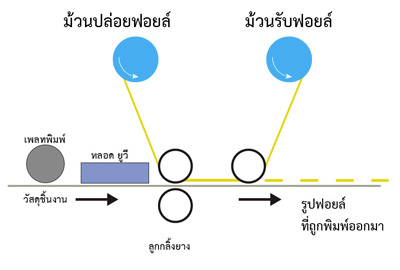
Figure 1 – Cold Foil Printing System
The quality of cold foil printing may encounter issues if the adhesive applied is insufficient due to substrate absorption. This is a point of caution, which is why film-based, glossy substrates are most suitable for the cold foil process and deliver better results compared to hot foil stamping.
The adhesive used in cold foil printing is therefore a critical part of the process, and there are two main types: free radical and cationic.
The cationic system was widely adopted earlier but was later proven to be more difficult to use, requiring highly skilled operators to achieve excellent results. Nowadays, free radical adhesives are preferred because they are easier to print with, user-friendly, and deliver more stable printing results.
Advantages and Disadvantages of Hot Foil vs. Cold Foil Printing
Hot Foil PrintingAdvantages
- Hot foil stamping produces brighter, more reflective foil colors.
- Hot foil allows a wider variety of finishes, including holographic effects.
- Hot foil stamping is suitable for combining foiling and embossing in a single pass.
- Hot foil stamping requires dies and heat, making the process more expensive.
- Preparation time for hot foil is longer, as dies are usually outsourced.
- It involves more production steps overall.
Advantages
- Cold foil units can be more easily retrofitted onto existing presses.
- No need for magnesium, copper, or brass dies.
- Requires only a printed image to define the foil area.
- Cold foil presses run faster than hot foil stamping.
- In production, registration between print and foil areas is highly accurate.
- Cold foil printing has lower setup costs compared to hot foil stamping.
- It allows for halftone foil printing.
- Cold foil cannot achieve the same fine detail as hot foil stamping.
- The result is less bright and reflective compared to hot foil.
- Darker colored foils are generally not recommended for cold foil printing.
In conclusion, both cold foil and hot foil printing have their own strengths and weaknesses. The choice depends largely on the type of work the print shop specializes in. For customers, the opportunity to choose the foil process is usually limited, as each print shop has different machinery and capabilities, which may not provide enough variety for all options.