




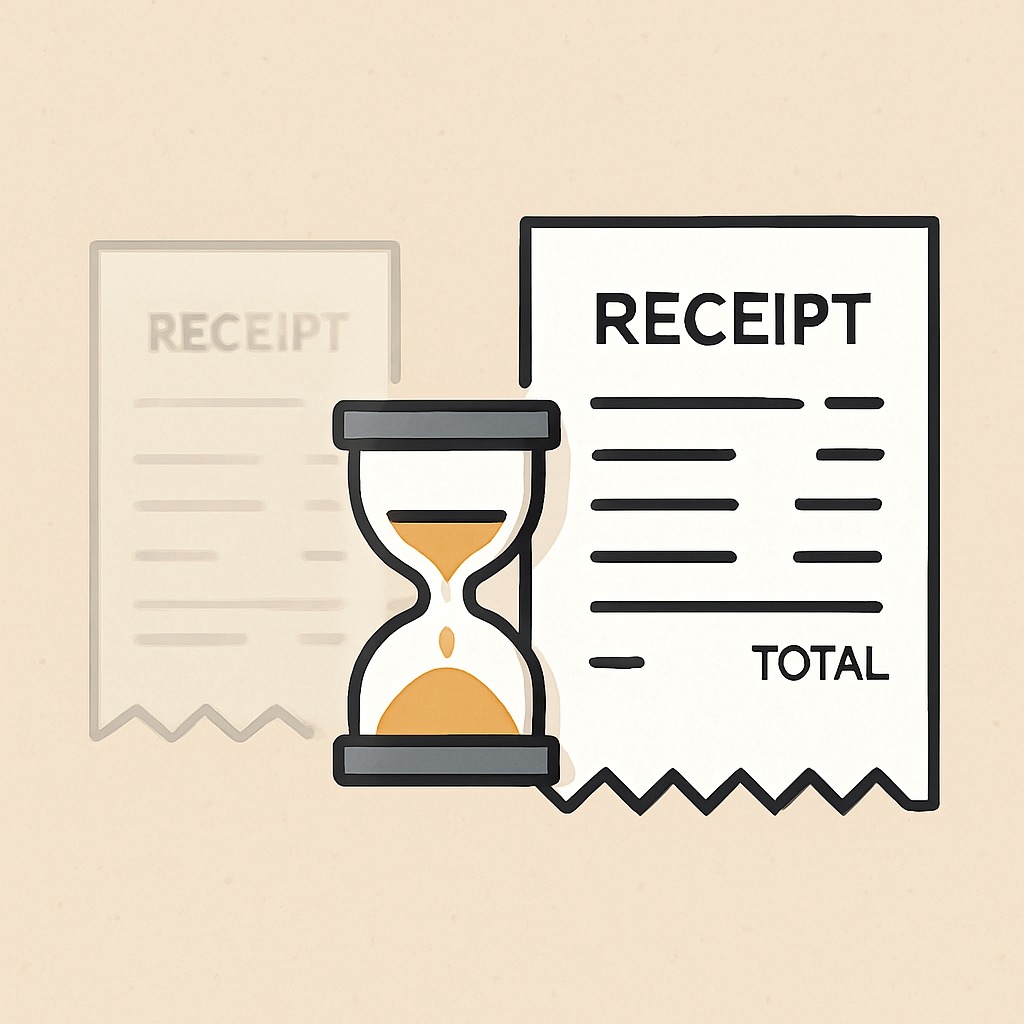
Many of us have experienced receipts fading quickly—barely legible after a short time. Whether it’s a payment receipt from a store or supermarket, a gas-station receipt, or even a tax invoice, you might later find that the text has faded so much it’s unreadable—or has almost disappeared. This makes audits and after-sales processes difficult, such as tax refunds and product warranty claims.
Why do receipts fade so quickly?
-
Most receipts are printed with thermal printers.
- Receipts from stores, supermarkets, convenience stores, and gas stations are often printed on “thermal paper,” which uses heat instead of ink: the print head heats a chemical coating on the paper to produce text.
- While fast and inexpensive, thermal paper has a short lifespan. Heat, humidity, sunlight, and chemicals can make the text fade quickly.
-
Paper and coating quality.
- Low-cost thermal paper often uses lower-grade coatings, which discolor or fade easily—especially under heat or UV light.
- Some businesses choose cheaper paper to cut costs without considering customers’ long-term record-keeping.
-
Improper storage.
- Storing receipts in hot places, near electronics, or in direct sunlight accelerates fading.
- Contact with plastics, alcohol, perfume, or other chemicals can also degrade the coating.
-
Ink-based receipts on bond/NCR paper.
- For handwritten or ink-printed receipts, low-quality paper or inks can fade with exposure to light and air.
- Substandard NCR (carbonless) paper can produce copies that fade within months.
What happens when receipts fade?
- Hard to audit later: Unreadable receipts cannot be used as reliable references.
- Warranty issues: Customers may be unable to claim warranties if no alternative proof is issued.
- Tax refund problems: Faded receipts may be invalid for VAT or other tax claims.
- Hurts brand trust: Quickly fading receipts reflect poorly on a business’s professionalism.
How to fix it: choose higher-quality papers to extend receipt life
-
Use high-quality thermal paper.
- Premium thermal papers use better coatings, resisting heat and light for longer. Text can remain legible for 3–5 years or more (depending on storage conditions).
- Buy from reputable manufacturers. The unit price is higher, but the long-term value is worth it.
-
Switch to ink-based receipts or NCR (carbonless) paper where needed.
- For records that must last, consider printing with ink on bond paper or using quality NCR sets—both are far more durable than thermal paper.
- Standard-compliant NCR produces clearer, longer-lasting copies than low-grade carbonless papers.
-
Choose premium bond or coated art papers for official documents.
- For tax invoices or corporate receipts kept long-term, use heavier bond or coated art papers (gloss/matte). They help maintain print clarity for years.
- Besides durability, they enhance your organization’s professional image.
-
Print care instructions or validity notes.
- If you must use thermal paper, add simple care tips on the receipt, such as “Store in a cool, shaded place with good ventilation,” so customers know how to prevent rapid fading.
Tips to keep receipts readable for longer
- For important thermal receipts, photocopy onto bond paper to keep a legible backup.
- Store in a cool, dry place; avoid heat and direct sunlight.
- Use opaque sleeves, paper envelopes, or sealed boxes; avoid contact with plastics, alcohol, perfumes, and chemicals.
- Scan or photograph critical receipts and keep digital copies.